Visa

Moving & Living - Haiti - Complete Guide
Plan the actual tasks of moving to Haiti: assess whether the move can proceed, arrange permission and work, prepare documents, and establish banking, residence records, housing, education and healthcare.
Photo credit
A move to Haiti can mean returning to family, a supported assignment, or study tied to a particular campus. Port-au-Prince, Cap-Haïtien, Jacmel and Les Cayes require different plans for work, services and journeys. French appears in much of the administration; Haitian Creole is important in everyday communication.
Current conditions must come first: the UK advises against all travel and the United States maintains a Level 4 advisory. This guide explains the practical sequence for people assessing a move, returning residents and those already in Haiti. The first decision may be to defer departure while arranging the documents and support needed.
Haiti at a glance
- Capital
- Port-au-Prince
- Currency
- Haitian gourde · HTG
- Communication
- Haitian Creole and French
- Residence
- DIE · permis de séjour
- Tax identification
- DGI · NIF
- Pension insurance
- ONA, subject to eligibility
- Electricity
- EDH
- Water authority
- DINEPA / regional and local operators
- Country calling code
- +509
- Reviewed
- 14 October 2026
Follow your moving journey
Start at step 1, or jump to the task you are working on.
01Decide whether the move can proceed, then choose the actual base
Start with the current UK travel and insurance advice and US Haiti advisory. These advise against travel; an attractive district, family connection or institutional website cannot establish that a journey is presently workable. For a supported assignment, obtain the organisation’s assessment of the address, transport and medical arrangements. For a family return, identify who can confirm the actual conditions on the ground.
| Possible base | What determines the decision |
|---|---|
| Port-au-Prince, including a specific Pétion-Ville, Bourdon or Tabarre address | Work/school entrance, supported movement and available services at that property |
| Cap-Haïtien or nearby Limonade | Northern assignment, family arrangements or a confirmed campus programme |
| Jacmel | The actual household purpose and access to the required services |
| Les Cayes and the Sud department | Regional work/family needs, medical access and a workable arrival plan |
- Identify the reason for moving and which household members need to be present.
- Ask the receiving employer, institution or trusted local contact to confirm the proposed address and necessary journeys.
- Confirm accommodation, arrival transport, medical arrangements and communication before booking departure.
- If those arrangements cannot be established, defer departure while completing the preparatory tasks below.
Compare complete arrangements rather than ranking neighbourhoods as universally safe. A move from one city to another also changes banking, immigration appointments, schools and provider coverage. Put the real office or campus address into the plan before searching for a permanent home.

02Resolve entry and the intended residence basis for every traveller
Ask the competent Haitian consulate about your passport, intended duration and actual purpose. British citizen visitor guidance gives visa-free visits of up to 90 days and a six-month passport-validity requirement. It expressly separates longer stays, employment, study and business activity. Apply the rules for your own nationality rather than assuming that example covers the household.
The Haitian Embassy in Washington’s tourist-visa page names nine nationalities requiring a visa, but its repeated list inconsistently omits Yemen. Obtain explicit confirmation if your passport is in a listed or uncertain category. The published application instructions call for a signed form, two photographs, purpose/address details, passport, travel reservation and employer letter, with submission at least a month before departure.
- Give the consulate your nationality, current country of residence, purpose and proposed dates.
- Ask whether the application belongs at that post, and what document legalisation or additional evidence applies.
- Obtain the required decision and keep the application record.
- For a longer stay, organise the DIE residence-permit process and the support evidence before arrival.
- Repeat the assessment for partners, children and other accompanying people; do not treat one person’s approval as everyone’s status.
Humanitarian or NGO employment does not automatically make an ordinary passport an official travel document. Diplomatic and official visas have their own passport and institutional-request conditions. Have the organisation establish the applicable route rather than promising staff an exemption based on the organisation’s purpose.
No general digital-nomad or retirement visa is verified by these sources. Present the proposed activity and means of support to the consulate and DIE, then obtain the appropriate instructions before planning to remain.
03Agree the job, permissions and operational support before starting
A written offer should identify the location, duties, salary currency, payment method, permitted starting date, leave and termination arrangements. For an assignment, also specify accommodation, transport, medical assistance and who funds a delayed start or an early departure.
The government’s published labour-management procedures summarise the foreign-worker permission requirement through the Direction de la main-d’œuvre, including paid independent activity. This is distinct from DIE residence permission. It is a 2021 procedural document, so ask the employer and MAST for the current application evidence, fee and receiving-office arrangements rather than assuming old contact details remain operational.
- Have the employer establish the applicable employment permission and any exemption specific to the role.
- Prepare the signed contract and professional qualifications requested by the authority.
- Allocate the employer’s corporate, NGO-authorisation and compliance evidence to a named administrator.
- Agree that the starting date follows the permission actually needed to perform the work.
- Retain decisions and renewal conditions with the contract, including instructions if the assignment ends.
The DGI foreign-activity licence is another distinct administrative and tax item; it should not be confused with the work permit. Its older online formulas need a current assessment following the October 2026 fiscal transition.
For business activity, use the government’s CIP procedure to map DGI documentation, MCI filing and the applicable inspection. A foreign-company branch has a separate legalisation, translation and MCI registration sequence. Engage a local lawyer for the entity and regulated activity concerned. Registering a company is not evidence that its owner may work or that the proposed premises can open immediately.
04Price the whole arrangement and establish current tax treatment
Build the budget from quotations for the actual household. Write HTG or USD on every item; clarify payment currency and conversion method before accepting an amount described only as “dollars.” Record the quotation date and whether transport, maintenance or tax is included.
| One-time arrival costs | Recurring costs |
|---|---|
| Travel, temporary accommodation and arranged transfer | Rent, supported travel and routine household purchases |
| Document translation, medical/police evidence and applications | Tax provision, payroll deductions and insurance |
| Deposit or agreed advance, furniture, shipping and clearance | Water supply, electricity/backup running costs, phone and internet |
| School applications and any pet preparation | Tuition, medicines, maintenance and household support |
A hypothetical USD800 rental requiring two months’ advance and a USD800 refundable deposit would use USD2,400 for those items alone. This illustrates the written terms of an imagined contract; it is not a Haitian rent average or a legal deposit rule. Add the quoted initial costs and retain accessible funds for delays and changed arrangements.
BRH’s 13 October 2026 reference was 130.5106 gourdes per US dollar. A reference rate is not a guaranteed bank conversion or transfer quote. Ask the provider for the amount the recipient will actually receive and the date funds become usable.
A 28 September MEF statement identifies 1 October 2026 as the implementation milestone for the new fiscal code. Older DGI pages remain useful for locating obligations, but this guide does not treat their historical rate tables as a verified post-transition assessment. Contact DGI with the job, residence, foreign-income and business details and request the applicable current treatment.
The income-return guidance distinguishes domicile and Haitian-source income; do not assume that foreign nationality or a foreign bank account removes the obligation. Have payroll explain deductions and the documents you will receive, and retain income and arrival-date records for the applicable return.
05Confirm education, admission and the way lessons will be delivered
For children, choose a curriculum and language arrangement they can realistically follow, then contact the school about year placement, support needs and current teaching arrangements. A school’s published calendar does not by itself confirm that every lesson will run on campus throughout the year.
Union School’s admissions page is a starting point for its US-accredited programme. Request the current packet and confirm the campus journey. Its 2025–26 detailed packet describes identity and health evidence, school reports/transcripts, references, application payment, placement testing and committee review. Ask for the 2026–27 update rather than applying the previous year’s tuition or conditions unchanged.
- Send the child’s age, current class and curriculum, and describe any learning or medical support needed.
- Obtain the evidence checklist and academic-year quotation, including charges beyond tuition.
- Complete the application and assessment; wait for a written decision.
- Ask how attendance, transport and any remote-learning period will work.
- Choose accommodation only after confirming the practical journey and teaching arrangement.
The Lycée Français Alexandre Dumas publishes 2026–27 application information for its French programme. Its website could not be accessed reliably during review, so obtain the packet directly from the school rather than bypassing the access problem or borrowing a different Alexandre Dumas school’s information.
For university, UEH’s 2026–27 instructions specify NIF, secondary certification or MENFP equivalence, and HTG800 per chosen entity, up to three. Pay through the stated SOGEBANK channel, complete the online application, print it and attend the entity’s validation before the entrance examination. Dates are entity-specific. The Limonade campus’s September validation dates have already passed; confirm any remaining route instead of assuming an open intake. Foreign credentials and immigration permission require their own assessment.
06Plan a return or retirement around status, income and care
Returning Haitian citizens should start with their own nationality and identity documents. The MHAVE diaspora portal provides document and return-service starting points, but diaspora support does not establish a foreign spouse’s residence or an automatic customs exemption.
- Confirm which traveller is a Haitian citizen and which needs a foreign-resident process.
- Resolve missing birth, marriage or identity records before departure where possible.
- Ask pension providers about overseas payment, proof-of-life requirements, reporting and a changed address.
- Obtain insurance and a plan for the actual ongoing treatment needs before selecting a long-term home.
- Retain enough independent access to funds to cover the period before local arrangements are complete.
For someone with an ONA contribution history, use ONA’s pension-application guidance. It identifies age 55, 240 contributions and cessation of remunerated activity among the ordinary eligibility conditions, followed by presentation of the insured card or booklet for assessment. Previous records matter; a new arrival does not acquire a pension simply by moving.
Check the correct scheme with ONA rather than transferring a police-specific pension programme to ordinary private employment. The legal framework also distinguishes compulsory coverage and exemptions, including some foreign diplomatic or specially exempt situations.
A foreign retiree should obtain DIE’s assessment of the proposed stay and evidence of support. No general retirement-visa entitlement is established here. Consider whether the household can obtain routine care, specialist assistance, reliable payment access and necessary journeys at the selected location. If those arrangements remain unresolved, keep the retirement move provisional.
07Prepare the originals, shipping instructions and animal documents
Make a traveller-by-traveller document index and a separate household inventory. Keep originals in cabin baggage, with protected copies accessible if the main device is lost. Separate documents needed at entry from evidence needed later at DIE, a bank, DGI or a school.
- Obtain identity and relationship records, including any consent or custody evidence required when travelling with children.
- Arrange French translation of the birth record required by DIE. Ask which other documents need translation or certification.
- Follow the document-legalisation sequence for the specific document: competent preliminary certification where needed, the applicable DGI receipt and submission/collection through MAEC. Confirm current office arrangements and retain the collection acknowledgement.
- Time the residence medical certificate to DIE’s published 30-day condition. Prepare recent police evidence and the required photographs.
- Ask the shipping agent for itemised freight, storage, tax and clearance quotations and who receives the goods.
The embassy’s relief-donation clearance instructions apply to relief goods and designated institutional processes. They do not establish that private household belongings can enter duty-free. Give your agent the actual inventory and residence circumstances and obtain the applicable customs instructions before dispatch.
For a pet, France Diplomatie’s Haiti instructions identify animal identity, current rabies records and a titration record. Give the Haitian consulate and veterinarian the species, origin, vaccination/testing dates and proposed entry point, and obtain the destination’s current permit and clearance conditions. Arrange airline acceptance separately. The published advice does not verify a universal current import fee or processing time.
08Complete iKat and use the arranged arrival plan
Use DIE’s iKat instructions and the linked official travel form for each traveller, including children. Provide accurate identity, journey, health and customs information, then save the QR code on the phone and on paper. The form is a travel declaration, not residence or work permission.
DIE’s page mentions 72 hours in its introduction and 48 hours in its FAQ. Resolve the current timing with DIE and the carrier ahead of the journey rather than waiting until an airport checkpoint. Complete a fresh declaration for each required arrival or departure and retain the reference for corrections.
- Reconfirm the carrier’s operation, entry requirements, connecting-country permission and the arranged transfer before setting out.
- Carry the relevant approval, sponsor contact, address and travel evidence where you can reach them.
- Present the required travel declaration and documents, then retain the entry endorsement and latest boarding card for subsequent administration.
- Notify the receiving contact after arrival and use the agreed transport and accommodation plan.
- Confirm the bank and DIE arrangements before travelling to an office.
British citizen guidance records a USD10 tourist entry charge and a USD55 departure tax often included in the international ticket. Verify your own circumstances and what the carrier has already collected; those charges are separate from permission to live or work.
Do not build the itinerary around an assumed overland connection from the Dominican Republic. The current UK access information reports the border closed to travellers and conditions subject to change. Obtain a confirmed lawful itinerary rather than using an old route description as proof that you can cross.
09Arrange the bank account and attestation needed for residence
DIE’s residence checklist includes an attestation from a bank in Haiti. Discuss this dependency with the bank and sponsor early: ask what identity, address and status evidence the bank accepts while the residence application is being prepared. Do not assume either institution will waive its requirements.
UNIBANK’s individual savings-account instructions list accepted official ID including a passport, address evidence and email for people living in Haiti. It posts an opening deposit of HTG650 or USD5; those are account funds, not an application fee. People living abroad are directed to its dedicated branch for a different evidence list.
- Tell the branch your nationality, current location and residence-application stage.
- Confirm whether the proposed address evidence is acceptable, particularly when a bill is in the landlord’s name.
- Provide the required documents and retain the opening record after approval.
- Ask for the particular attestation DIE requires and confirm the evidence and balance it must show.
- Test access and establish the permitted payment methods before using the account for all expenses.
DIE posts a bank-evidence minimum of HTG7,500 or USD200. These are the authority’s alternative stated amounts, not exchange-rate equivalents; ask which wording and account evidence it currently accepts. An opening deposit alone does not satisfy a larger attestation requirement.
Compare the account tariff with your intended use. UNIBANK’s current-account page posts HTG1,300 or USD10 monthly plus TCA, illustrating why account type matters. Obtain the applicable final tariff, withdrawal/transfer limits and online-access conditions. Verify a landlord’s or supplier’s beneficiary details through a known contact before the first substantial payment, and keep receipts.
10Complete residence, tax identification and the applicable employment records
For the DIE residence-permit application, prepare the request letter explaining your reason, passport biographical copy and employment or support letter. Its sponsor evidence includes the employer’s patente or an NGO operating authorisation where applicable. Add the medical certificate, two passport photographs, latest boarding-card copy, birth record with French translation, bank attestation and recent origin-country police record.
- Ask DIE which office handles the foreign-resident file and obtain current appointment and document instructions.
- Present the complete evidence, attend the interview and complete the application form.
- Pay the confirmed charge through the specified method and retain the official receipt. DIE posts HTG5,000 by manager’s cheque to the Trésor public, without an effective date.
- Record the permission’s actual validity, conditions and renewal process when issued.
The DIE centre directory does not establish that every listed passport centre processes foreign residence. Confirm the receiving service before making a journey. Keep a pending-file acknowledgement separate from an issued permission.
For NIF, DGI’s foreign-applicant instructions specify the applicable residence or diplomatic document in place of the citizen identity evidence, followed by the prescribed form. Ask DGI how to proceed if another necessary transaction arises before the residence document is issued. Its page contains several historical fee schedules; request the current assessment after the fiscal transition instead of choosing the cheapest figure.
For insurable private employment, coordinate registration with the employer and obtain the insured card or booklet. ONA describes ordinary employee and employer contributions of 6% each, with a different voluntary arrangement. Confirm your actual coverage and any exemption; retain contribution records. Pension insurance, a residence certificate and health insurance are separate arrangements.
11Inspect the home and agree the rental and service responsibilities
Use a trusted local representative to establish the offered property and the landlord’s authority where personal viewing is not appropriate. Obtain photographs and a condition report of the actual unit, but remember that an image alone cannot confirm water, electricity, structural condition or access.
- Match the address, unit and person granting occupation to the ownership or agency evidence. Use a local lawyer or notary for disputed authority or a substantial commitment.
- Inspect entrances, stairs, roof and drainage. Have water, power and any advertised backup equipment demonstrated.
- Write the rent currency, payment dates, term, advance, deposit-return conditions, repairs, access and termination rules into the agreement.
- Identify who pays for water delivery, pumping, power backup, internet, maintenance and any shared charges.
- Record keys, furniture, equipment condition and meter readings and obtain both parties’ acknowledgement.
Discuss what happens if work, school or movement arrangements change. A clear short-term or exit provision is more useful than an informal assurance that an advance “will be sorted out.” Retain receipts that identify the address and period paid.
Ask about the actual source and storage of water, who cleans the tank and how replacement supply is obtained. Check which electrical equipment belongs to the property and who maintains it. A rental price described as inclusive should identify precisely what is included and any limits.
This guide does not assert a national deposit cap, a standard mandatory advance or a universal lease term without verified applicable law. Have the proposed agreement reviewed for that property and arrangement before paying a substantial non-refundable amount.
12Confirm routine care, funding and the medical contingency
Begin with the household’s actual needs: regular medicines, pregnancy or paediatric care, ongoing treatment and specialist follow-up. Ask the insurer to address residence, work, current travel advice, exclusions and evacuation arrangements in writing. A purchased policy does not establish cover for every circumstance.
- Choose an accessible receiving clinic and ask about current appointments, services and payment.
- Prepare a short medical summary, prescriptions using medicine names and relevant test results.
- Verify supply of regular medicines and arrange a lawful initial supply with the treating clinician.
- Ask which hospital receives urgent or specialist cases and who coordinates a transfer.
- Keep the insurer’s authorisation and assistance contacts available to another household member.
In northern Haiti, Hôpital Sacré Coeur in Milot publishes emergency, outpatient, maternity and other services. Contact the facility about the required service and current admission arrangements; a published service description is not proof that a bed, specialist or journey will be available when needed.
In Port-au-Prince, MSF’s Isaïe Jeanty maternity update records an August 2026 interruption followed by resumption on 18 August. Quoting only the original suspension would be misleading, while the resumption does not guarantee uninterrupted future operation. Verify a receiving facility at the time care is needed.
Use MSPP for official public-health information and current notices. The UK emergency directory lists ambulance 116, fire 115 and police 122, while noting that response can be unavailable or delayed. Keep a confirmed local assistance plan in addition to the numbers, with the actual address and contact person ready to give to responders.
13Establish water, power, communications and agreed journeys
Confirm the property’s electricity account and supply through EDH’s official directory. Ask the owner for recent bills, account identification and responsibility for existing balances. If equipment provides backup, have a qualified person explain operation, maintenance, ventilation and permitted loads; record who pays the running costs.
For water, identify the local operator through DINEPA and the relevant regional or local service. The DINEPA contract model is a useful explanation of the operator/subscriber relationship, but it is an older technical model rather than a current national tariff or automatic contract for your address. Obtain the actual subscription, source, schedule and charge from the responsible operator.
- List each service, account holder, payment method and contact.
- Have the owner resolve the account-transfer or new-connection requirements with the provider.
- Test communications inside the home and at the required work location.
- Save account references and fault-report contacts and keep copies of the first bills.
Digicel’s prepaid page posts a 30-day HTG1,800 bundle with 18GB and 500 Digicel minutes for specified eligible profiles, tax included. Confirm eligibility and the actual allowances on your SIM before purchase; a bonus balance is not necessarily unrestricted cash or data. Use the provider’s own activation channel and keep the confirmation.
For fixed internet, Access Haiti’s coverage and service page is a starting point for an address-specific quotation. Obtain the final currency, taxes, equipment, installation and power requirements rather than assuming website headline offers apply to every property.
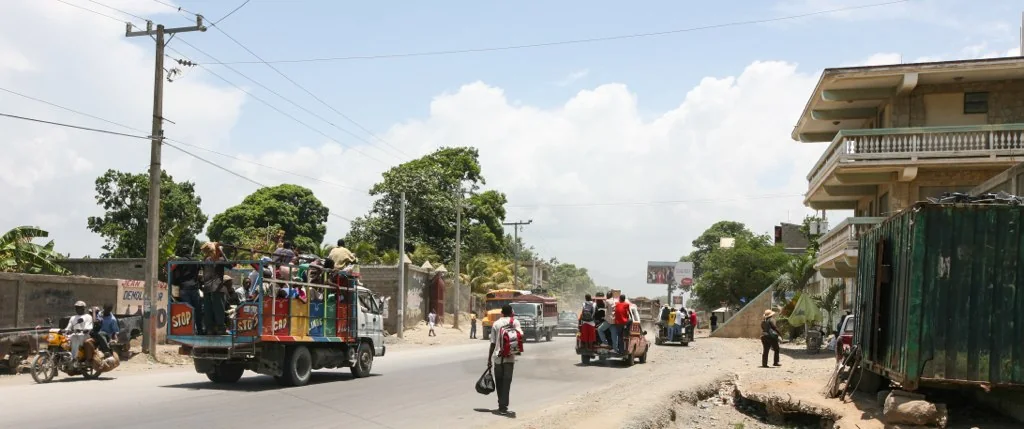
Arrange daily movement through the employer or confirmed local support. For any proposed driving, ask the responsible authority about recognition of your foreign licence and the local licence process; no automatic foreign-licence conversion is verified here. The archival road scene below illustrates transport, not a recommended present-day route.
14Review the first month and organise records, contacts and renewals
Set aside a short weekly administrative session. The purpose is to replace provisional arrangements with confirmed records and address the remaining dependencies without making repeated unplanned office journeys.
| Task | Evidence to retain |
|---|---|
| Residence and activity permission | Issued decision, receipt, conditions and actual expiry |
| Bank, NIF and employment | Accepted account/attestation, tax record, contract and first payslip |
| Housing and utilities | Agreement, inventory, initial readings and named provider contacts |
| Education and healthcare | Placement, attendance arrangement, receiving clinic and insurer instructions |
| Travel and emergency planning | Current arrangements, assistance contact and required declaration records |
Compare the first actual bills and deductions with the quotations. Separate one-time setup charges from recurring spending and investigate unexplained differences through the named provider. Update the budget using what your household pays at that location.
Build community through family, colleagues, the school’s parent channels or the university’s existing activities. Ask about current participation arrangements rather than turning an old festival or venue listing into an outing recommendation. Learning practical Haitian Creole phrases can improve ordinary communication with neighbours and service workers; clarify important contract and medical information in a language everyone understands.
Keep copies of notices and decisions together, and record who is responsible for each renewal. Returning Haitian citizens can use MAEC’s consular services for the relevant Haitian documentation. Foreign nationals should ask their own consulate about registration and available assistance, preserving the distinction between consular support and guaranteed local services.
If essential arrangements stop working, revisit the first decision with the receiving organisation or trusted contacts. A successful plan includes a way to defer, change accommodation or leave when needed. The guide’s photographs remain identified by their capture dates; none is evidence that a district, route or service is presently available.
Sources & further reading
Reviewed 14 October 2026. Sources are linked beside the relevant instructions. Entry, residence, work permission and a foreign-activity licence serve different purposes. Service availability depends on the actual location and conditions. iKat’s published timing instructions contain a 72-hour/48-hour inconsistency, identified in the preparation step. Original school information is used with its academic-year scope; uncertain current procedures are directed to the responsible institution. Prices were checked on 14 October 2026. Provider amounts without an effective date are labelled posted; confirm eligibility and the final charge. UEH application fees refer to its 2026–27 instructions. BRH’s exchange reference retains its 13 October date. Rental arithmetic is hypothetical. Current tax assessments must account for the October 2026 fiscal-code transition; older administrative fees and income-tax tables are not presented as current. Photograph credits, licences and capture years appear with the images.
Browse the source directory
- FCDO — current Haiti travel and insurance position
- US State Department — Haiti advisory
- FCDO — British citizen entry rules
- Haitian Embassy Washington — tourist visas
- Haitian Embassy Washington — diplomatic/official visas
- DIE — residence-permit process
- DIE — administrative centres
- DIE — iKat instructions
- DIE — actual iKat form
- MTPTC — official labour-management procedures
- DGI — foreign-activity licence
- Government services — professional identity card
- Government services — foreign-company branch registration
- MEF — fiscal-code implementation milestone
- DGI — official tax information and contact
- DGI — annual income return
- DGI — individual tax identification
- BRH — currency and dated exchange reference
- Union School — admissions
- Union School — detailed admission packet
- Lycée Alexandre Dumas — published2026–27 admissions
- UEH — 2026–27 applicant instructions
- UEH Henry Christophe — applicant notice
- ONA — coverage and contributions
- ONA — legal framework
- ONA — current pension application guidance
- MHAVE — diaspora services
- Government services — document legalisation
- France Diplomatie — Haiti entry and pets
- Haitian Embassy — relief-goods clearance
- UNIBANK — individual savings account
- UNIBANK — current account
- MSPP — public health publications
- Hôpital Sacré Coeur/CRUDEM — services
- MSF — Isaïe Jeanty service update
- FCDO — Haiti emergency contacts
- Government directory — Electricité dHaïti
- DINEPA — water service contract model
- DINEPA — responsible water authority
- Digicel Haiti — prepaid offers
- Access Haiti — internet and coverage
- FCDO — transport and regional access
- Government services — driver licence
- MAEC — consular and legalisation contact
Make your next step a practical one
Establish whether the move can proceed with confirmed local support, then coordinate each traveller’s permission, the employer or school arrangements, and the bank evidence needed for residence.